|
|
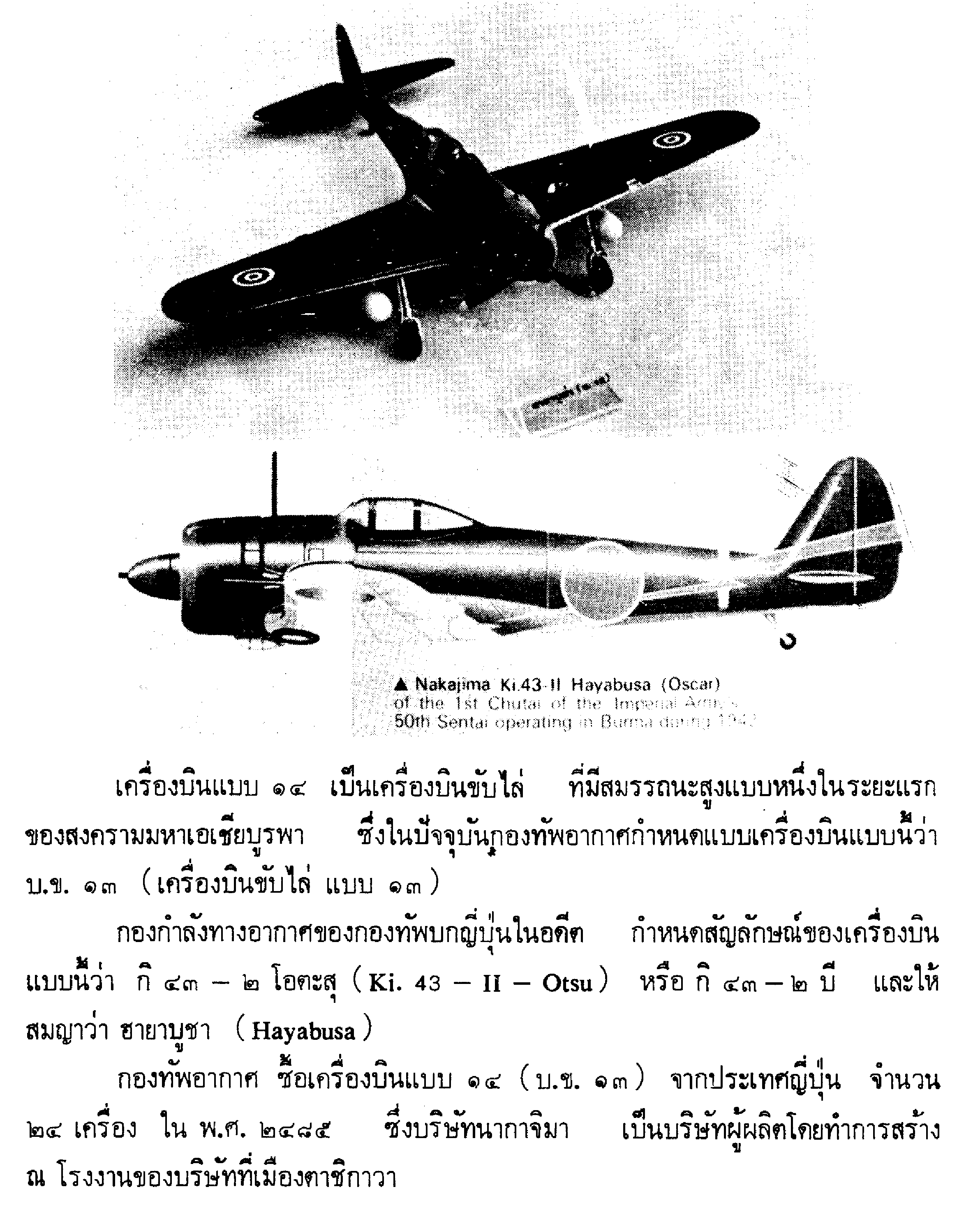
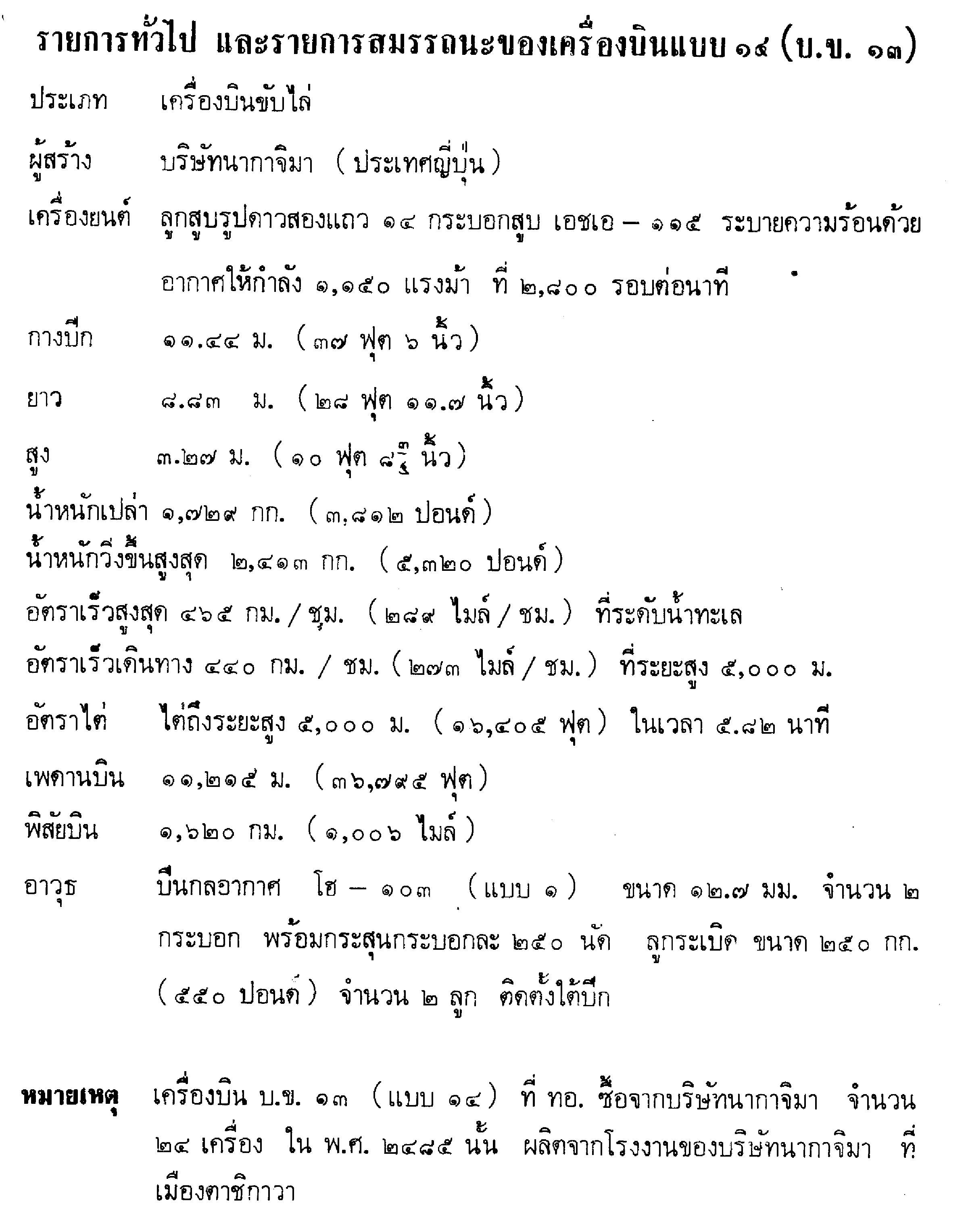
-
»ÃÐÇѵԡͧ·Ñ¾ÍÒ¡ÒÈä·Â ã¹Ê§¤ÃÒÁÁËÒàÍà«ÕºÙÃ¾Ò ¾.È. òôøô - òôøø, ·Í. ¾.È. òõòõ, ˹éÒ óòô-óòõ.
Nakajima Ki-43 Hayabusa (Oscar)
Nakajima Ki-43 Hayabusa (Oscar)
-~- Written and Researched by Paul D. Alexander
Allied fighter pilots, before the Pacific War began, were often told the silliest things about their possible antagonists, the Japanese. British and Commonwealth flyers in Malaya, for example, were told by their intelligence officers that the best aircraft available to the Japanese were fabric-covered biplanes no better than the best planes used on the old Western Front in World War I! So when the war burst upon them in all its fury, they were astounded-often fatally-by the excellence of the Japanese equipment they faced in their obsolescent Brewster Buffalos. In addition to the Navy’s Mitsubishi Zero, they encountered quantities of a similar but smaller and much more lightly-armed fighter flown by the Japanese Army. This was the Nakajima Ki-43, nicknamed the Hayabusa (Peregrine Falcon), and later code-named Oscar.
The Hayabusa was a sleek little dogfighter, relatively slow and lightly armed (just two fuselage-mounted machine guns at a time when other fighters were carrying multiple machine guns or even cannon in their wings). At first, these weaknesses seemed not to matter, but as time went on, the Hayabusa was totally outclassed by its opponents in every respect except tight-turning dogfighting. And even that advantage counted little against enemy aircraft that refused to meet the Hayabusa on its own terms. Unfortunately for Japan, the Hayabusa had to continue on as a front-line fighter to the end, because its successor-the Ki-84 Hayate (which see)-was never available in sufficient quantities, and was not as reliable as the older fighter.
Interestingly, design work on the Ki-43 began even before its predecessor, the Ki-27 Nate, entered service with the JAAF. In December 1937, the Army told the Nakajima company to design a new fighter to supercede the Ki-27. The new plane would be faster in level flight (300+ mph), swifter-climbing (5 minutes to 16,405 ft.), longer-ranged (a radius of action of 500 statute miles), with the same armament and maneuverability as the earlier fighter. The Nakajima team, led by Hideo Itokawa, worked steadily for a year, and the new plane was first flown early in January 1939.
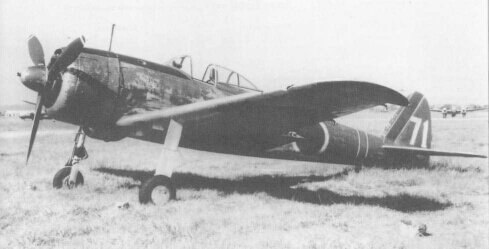
A Ki-43-I of the Akeno Fighter School.
The first three prototypes were powered by a Nakajima Ha-25 fourteen-cylinder, twin-row, radial air-cooled engine. Compared to the later production models, they lacked cowl flaps and had a larger canopy with a lot of metal framework. The fuselage of the prototypes was also shorter and the vertical stabilizer was differently shaped. These three were all armed with two fuselage-mounted 7.7mm machine guns, and-a major first for a Japanese Army fighter-they had retractable main landing gear.
Although the prototypes met nearly every Army performance requirement, service test pilots criticized the new fighter as being sluggish and hard to maneuver compared to the Ki-27. Some of them even wanted to revert to fixed landing gear, seeing retractable gear as a weighty luxury. Further prototypes were built, introducing the standard canopy, long fuselage, forward-mounted radio antenna, heavier armament (twin 12.7mm machine guns), and-finally-a special flap called a “butterfly” or “combat” flap. This flap could be extended in action to provide greater lift and enable a tighter turning circle. This one feature made believers out of the service test pilots; they were now quite enthusiastic about the new fighter.
Just before the opening of the Pacific War, the plane was accepted for service and was formally named the Army Type 1 Fighter Model 1A, or Ki-43-Ia Hayabusa. This first production type was armed with twin 7.7mm machine guns, and was powered by a Nakajima Ha-25 engine driving a two-bladed fixed-pitch propeller, later replaced in the field and in the factory with a variable-pitch two-bladed propeller of the Hamilton-Standard type. It could also carry two drop tanks on attachment points under the wings and behind the undercarriage. The 59th and 64th Sentais (Fighter Groups) were the first to use the Hayabusa in combat, over Malaya and Burma in the early days of the war.
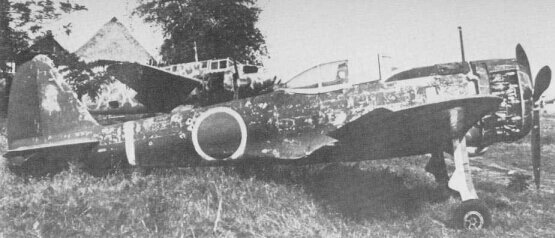
Ki-43-II abandoned in the Philippines, 1945; Ki-45 in background.
The Ki-43-Ia was soon followed by the outwardly similar Ki-43-Ib, which differed from the first type solely in replacing one of the 7.7mm guns with a 12.7mm weapon. The final and major subtype of this series was the Ki-43-Ic, which standardized on twin 12.7mm machine guns-this became the standard armament for the Hayabusa for the rest of its career.
The Hayabusa was quickly recognized as one of the best and most feared Japanese warplanes of the early wartime period, despite its light armament and its lack of pilot and fuel-tank protection. It was at first thought to be a retractable-gear variant of the Ki-27 Nate, and was code-named the Jim in the China-Burma-India theater. In the Southwest Pacific, it was seen as a type all to itself and was coded the Oscar; eventually, the latter name was made standard when it was discovered that Jim and Oscar were actually the same aircraft.
The next version of the Oscar, the Ki-43-IIa, was test flown in February 1942. This version had a 1,150 hp Nakajima Ha-115 engine, with a two-stage supercharger, and driving a three-bladed constant-speed propeller. Despite minor engine teething troubles, the flight testing went smoothly, and the -IIa entered production in November 1942. Aside from the new engine and propeller, the -IIa differed from the -I in other respects. The supercharger intake was moved to the upper lip of the engine cowling while the carburetor intake remained on the lower lip. Wing span and wing area were reduced to improve the plane’s level speed. The former telescopic gunsight was replaced by a modern reflector sight, the canopy was heightened slightly, and the underwing attachment points were strengthened to enable the Hayabusa to act as a fighter-bomber, carrying two 551-lb. bombs. Acknowledging the Ki-43’s lack of protection, rudimentary self-sealing fuel tanks were installed in the wings, and 13mm head and back pilot armor was added.
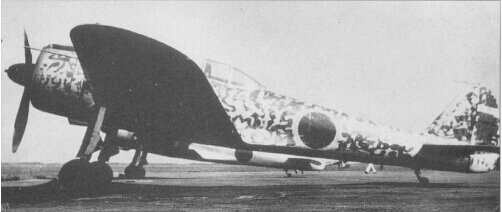
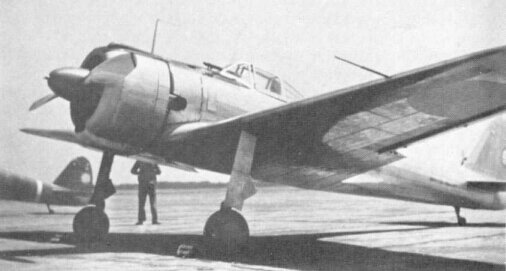
A fresh, new Ki-43-II in China, before being assigned to a unit.
The Ki-43-IIb swiftly overtook the -IIa on the production lines. Outwardly identical, the -IIb incorporated a new honeycomb oil cooler within a deepened carburetor intake. Later -IIbs had their underwing attachment points moved to a position outboard of the main gear legs, to prevent bombs from striking the propeller during dive-bombing attacks. Still later machines had the oil cooler removed from the carburetor intake, and repositioned under the fuselage center-section. All of these progressively introduced modifications were finally standardized in the Ki-43-II-Kai, which also introduced individual exhaust stacks to provide some thrust augmentation; this replaced the exhaust collector ring used in all previous versions. The Ki-43-II-Kai was a beautiful machine, with hardly any vices. It could outmaneuver any Allied fighter with ease, but the Buffalo had been retired from combat, and the newer Allied fighters encountered over the CBI and Southwest Pacific-the Spitfire, the P-38 Lightning, the P-47 Thunderbolt, and early Allison-powered variants of the P-51 Mustang-could all outclimb and outdive the Oscar. The Ki-43 also could not withstand the greater firepower of its newer opponents, often disintegrating in mid-air when hit solidly. If an Allied pilot was aware of the Ki-43’s peculiar strengths and weaknesses, it could be successfully engaged even in later models of the P-40 Warhawk.
Shortly after the Ki-43-IIa’s introduction, the JAAF decided to engage other factories in turning out examples of the Hayabusa. Two Tachikawa-based facilities, the Army’s First Air Arsenal and the Tachikawa Airplane Company Ltd., were selected. But the Air Arsenal lacked the skilled personnel needed to mass-produce the Ki-43, and production ceased there after just 49 Ki-43-IIas, mostly assembled from Nakajima-supplied components, were completed in a thirteen-month period (October 1942-November 1943). But the Tachikawa Airplane Co. was better prepared for mass-production, and virtually took over all production of the Hayabusa after the summer of 1943. The Nakajima Company itself, though still creating prototypes, was trying to concentrate on production of the later Ki-44 and Ki-84 fighters.
The final Nakajima-designed variant was the Ki-43-IIIa of May 1944. Outwardly similar to the Ki-43-II-Kai, it had a 1,230 hp Nakajima Ha-115-II engine, and was the fastest production Oscar at 338 mph. Tachikawa handled all production of this variant, and also designed and built two prototypes of the Ki-43-IIIb, which were still being tested when Japan capitulated. This version had a 1,250 hp Nakajima Ha-112, or [Ha-33] 42 engine with improved high-altitude performance, and the former twin 12.7mm fuselage-mounted machine guns were replaced with twin 20mm cannon.
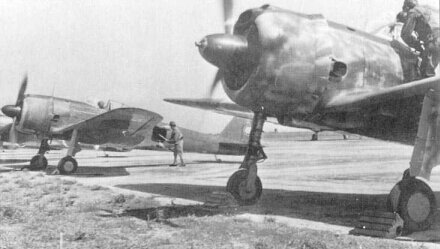
Two Oscars revving up their engines at the Akeno Fighter School.
A final total of 5,919 Hayabusas were built, of which Tachikawa manufactured 2,631, counting the two Ki-43-IIIb prototypes. Numerically, it was the most important JAAF airplane, and served on every front where the JAAF fought. By the war’s end, it had largely been replaced by newer types in front-line fighter units, and a large number were expended in Taiatari attacks (Army suicide attacks similar to the Navy’s Kamikaze attacks). Ki-43-Is were also operated by the Royal Thai Air Force, and were encountered by the US 14th Air Force in southern China. But the end of the war didn’t mean the end of the Oscar’s combat career; salvaged Ki-43s flew against the Dutch as the first equipment of the infant Indonesian Air force, and others flew briefly against the Viet Minh in Indochina, flown by the French Air Force.
Top of article
Type:
Single-seat, single-engined, land-based fighter and fighter-bomber, all-metal construction with fabric-covered control surfaces.
Accommodation:
Pilot in enclosed cockpit.
Power plant:
One Nakajima Ha-25 fourteen-cylinder air-cooled radial engine, rated at 980 hp for take-off and 970 hp at 11,155 ft., driving a fixed-pitch two-blade wooden propeller (prototypes and service test aircraft) or a variable-pitch two-blade metal propeller (Ki-43-I series).
One Nakajima Ha-115 fourteen-cylinder air-cooled radial, rated at 1,150 hp for take-off and at 8,040 ft., and 980 hp at 18,375 ft, driving a constant-speed three-bladed propeller (Ki-43-II series).
One Nakajima Ha-115-II fourteen-cylinder air-cooled radial, rated at 1,190 hp for take-off, 1,230 hp at 9,185 ft., and 950 hp at 22,310 ft., with propeller as for the Ki-43-II (Ki-43-IIIa).
One Mitsubishi Ha-112 ([Ha-33] 42) fourteen-cylinder air-cooled radial, rated at 1,300 hp for take-off, 1,200 hp at 9,845 ft., and 1,100 hp at 20,340 ft., with propeller as for the two preceding series.
Armament:
Two 7.7mm machine guns (Ki-43 Ia).
One 7.7mm machine gun and one 12.7 mm machine gun (Ki-43-Ib).
Two 12.7 mm machine guns (Ki-43-Ic, Ki-43-II series, and Ki-43-IIIa).
Two 20mm cannon (Ki-43-IIIb).
External stores:
Two 33-lb. bombs (Ki-43-I series).
Two 66-lb. or 551-lb. bombs (Ki-43-II and -III).
Two 44 gallon drop tanks (all versions).
Dimensions, weights, and performance:
Ki-43-Ia:
Wingspan, 37 ft. 6 3/16 in.;
length, 28 ft. 11 ¾ in.;
height, 10 ft. 8 ¾ in.;
wing area, 236.805 sq. ft.;
empty weight, 3,483 lb.;
loaded weight, 4,515 lb.;
maximum weight, 5,695 lb.;
wing loading, 19 lb./sq. ft.;
power loading, 4.6 lb./hp;
maximum speed, 308 mph at 13,125 ft.;
cruising speed, 199 mph at 8,200 ft.;
climb to 16,405 ft., 5 min. 30 sec.;
service ceiling, 38,500 ft.;
maximum range, 745 st. miles.
Ki-43-IIb:
Wingspan, 35 ft. 6 ¾ in.;
length, 29 ft 3 5/16 in.;
height, 10 ft. 8 ¾ in.;
wing area, 230.367 sq. ft.;
empty weight, 4,211 lb.;
loaded weight, 5,710 lb.;
maximum weight, 6,450 lb.;
wing loading, 28 lb./sq. ft.;
power loading, 5 lb./hp;
maximum speed, 329 mph at 13,125 ft.;
cruising speed, 273 mph;
climb to 16,405 ft., 5 min. 49 sec.;
service ceiling, 36,750 ft.;
normal range, 1,095 st. miles;
maximum range, 1,990 st. miles.
Ki-43-IIIa:
Wingspan, 35 ft. 6 ¾ in.;
length, 29 ft 3 5/16 in.;
height, 10 ft. 8 ¾ in.;
wing area, 230.367 sq. ft.;
empty weight, 4,233 lb.;
loaded weight, 5,644 lb.;
maximum weight, 6.746 lb.;
wing loading, 24.5 lb./sq. ft.;
power loading, 4.6 lb./hp;
maximum speed, 358 mph at 21,920 ft.;
cruising speed, 275 mph;
climb to 16,405 ft., 5 min. 19 sec.;
service ceiling, 37,400 ft.;
normal range, 1320 st. miles;
maximum range, 1,990 st. miles.
Sources: