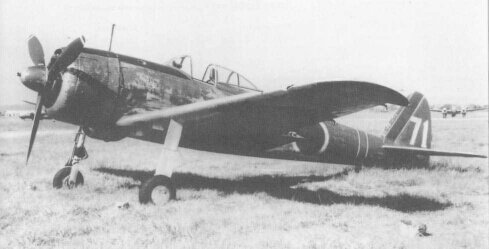
 A Ki-21-II warming up its engines on the tarmac of an airfield somewhere in Japan, 1943 The Ki-21 twin-engined bomber was the first Japanese bombing aircraft equal to the best available to Japan’s potential adversaries. A well-designed monoplane of sleek lines and excellent performance for its time, it was the mainstay of JAAF bomber groups throughout most of the Sino-Japanese War, the Khalkin Gol border war with the Russians, and well into the Pacific War. Although poorly armed by the standards of the latter period, the Sally, as it was code-named by the Allies, remained in first-line service for most of the war. Early in 1936, the Japanese Army decided to replace its aging Ki-1 and Ki-2 bombers, and issued a specification to Mitsubishi and Nakajima. Requirements included a normal operating altitude of 13,125 ft., a cruising endurance of over five hours at 186 mph, a maximum speed of 248 mph at 9,845 ft., a take-off run of less than 985 ft., and the aircraft to be powered by two 850 hp Nakajima Ha-5 or two 825 hp Mitsubishi Ha-6 radial engines. The new aircraft was to have a normal crew of four, with room for two more gunners if required, and defensive armament was to be three flexible machine guns in nose, dorsal, and ventral positions. The bomb load at full fuel loading was to be 1,653 lb., while for short-range missions, maximum bomb load was to be 2,205 lb. The design team led by Engineers Nakata and Ozawa had the first two prototypes of the Ki-21 ready by December of 1936, the first flight being made on the 18th of that month. Both planes were all-metal cantilever monoplanes with the wings set at mid-fuselage above the bomb bay. The second prototype differed from the first only in the shape of its dorsal gun position, having a long “green-house” canopy instead of a semi-hemispherical turret to reduce drag. The other two machine gun positions were identical in both aircraft, an angular glazed nose with a single 7.7mm machine gun, and a similar gun mounted in the ventral step.  Ki-21-Ic's of the Hamamatsu Bomber School in formation over the mountains of Hokkaido. The two Ki-21 prototypes were pitted against Nakajima’s Ki-19 in competitive service tests in March of 1937; a third design, the Kawasaki Ki-22, was not approved for prototype construction, so the two rivals-the two largest aircraft manufacturers in Japan-had the field all to themselves. The evaluation of the two competing designs culminated in bombing trials held at Hamamatsu in June (Hamamatsu was the location of the JAAF’s bomber school). The service pilots judged the Ki-21 to be a better performer as a pure flying machine, but the Ki-19 had more reliable engines and was a steadier bombing platform. So the Army ordered additional prototypes of both machines, and Mitsubishi was instructed to use the Nakajima Ha-5 engine in place of its own Ha-6, and also to improve the Ki-21’s handling characteristics. The third prototype Ki-21 was accordingly powered by the Ha-5s, and it also featured a new hemispherical nose cone with a wider field of fire for the nose-mounted machine gun. The ventral step was eliminated, and the vertical tail surfaces were redesigned. Directional stability, so important during the bombing run, was much improved, and the Ki-21 easily won a re-match against the Ki-19 at the Army Air Arsenal at Tachikawa. The Mitsubishi aircraft was therefore ordered into production in November 1937 as the Type 97 Heavy Bomber Model 1a (Ki-21-Ia) (to the Japanese Army, most twin-engined bombers were “heavy” bombers, when such an appellation would normally be applied to a four-engined bomber in America or Britain). The last five prototypes built were actually used as service-trials aircraft for testing operational equipment. Outwardly the production machines were identical to the third prototype and the service-test machines, but fuel capacity was increased from 405 gallons to 580 gallons to allow for the long ranges encountered in China. Mitsubishi built 143 examples of this type beginning in the spring of 1938. A production order had also been given to Nakajima to build its rival’s design, and between August 1938 and February 1941, 351 Ki-21s were made by Nakajima, including examples of the later Ki-21-Ib and Ki-21-Ic. The last two versions were designed by Mitsubishi in response to combat experience, as the Ki-21 had shown itself weak in defensive armament and fuel-tank protection over China. The Ki-21-Ib, 120 of which were built by the parent company, had two additional machine guns added to the three already carried-one in a waist mounting, where it could cover either side as needed, and one in the tail as a remotely-controlled “stinger”. It also had laminated rubber sheets to protect the fuel tanks, larger landing flaps, slightly enlarged horizontal tail surfaces, and an enlarged bomb bay. The Ki-21-Ic was similar, but added another waist-mounted machine gun, and could accommodate an additional fuel tank of 110 gallons capacity in the rear of the bomb bay (though when this was carried, the bomb load was cut down to just four 110-lb bombs). It also had larger landing wheels to compensate for the heavier weight. One hundred and sixty of these were built. The Ki-21-Ib and -Ic replaced the earlier -Ia as swiftly as possible in front-line units in China, the older bombers being withdrawn to training units and second-line sentais, or groups, in Japan. Some were also converted to transports for use by Japan Air Lines, being redesignated MC-21s. Mostly, they were used for freight, but they could carry nine passengers in a pinch. They plied the air routes between Japan and the Asian battle-fronts, mostly, as nearly all transports serving the Pacific Ocean area were operated by the Navy. Still other Ki-21-Is were field-modified to serve as communication and hack aircraft with various Army commands. 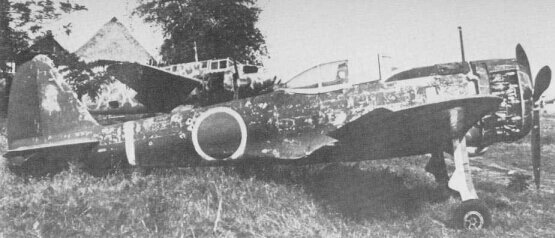 Camouflage won't save it now: a Ki-21-IIb about to be hit by a para-frag bomb, New Guinea, 1944. When facing the Chinese, the Ki-21-Ib and -Ic had proven themselves quite effective, but they had taken a beating against the Russians at Khalkin Gol, so the JAAF, in November 1939, instructed Mitsubishi to increase the airplane’s speed and ceiling. The first Ki-21-Ic was used as a developmental aircraft for the advanced Ki-21-IIa. It was fitted with two 1,500 hp Mitsubishi Ha-101 radials, and the engine nacelles were redesigned in order to house the larger Ha-101s and fully enclose the undercarriage. The fuel tank arrangement, armament, and other internal systems were unchanged, but the area of the horizontal tail surfaces was again enlarged to allow for the greater power of the new engines. Flight trials commenced in March 1940, and the first production Ki-21-IIas were delivered in December. Within a year’s time, most “heavy bomber” sentais were either operating the -IIa or else were still transitioning to it. The Japanese Navy transferred its main air strength to the Pacific front to face the United States, leaving the Army’s air arm to support the invasions of Thailand, Malaya, and Burma, and also continue to maintain pressure on the Chinese. On December 8th, 1941 (December 7th, US time), when the war began, the Army’s 3rd Air Division in French Indochina had three sentais equipped with the Ki-21-IIa, and immediately began supporting the landings at Kota Bharu. During the subsequent seven months, the Ki-21-IIs participated in the Dutch East Indies and Southeast Asian operations, and were prominent in the capture of Hong Kong and Rangoon. They were initially successful against obsolete Allied fighter opposition, but when pitted against RAF Hurricanes defending the border of India and P-40s of the American Volunteer Group (Flying Tigers) over Burma and China, Ki-21 losses rose sharply. One of the aircraft’s weakest points was its poor defensive armament; none of the machine guns had any but a limited field of fire-especially the dorsal gun in the archaic “greenhouse”. Starting with aircraft #1026, Mitsubishi replaced the greenhouse with a large, conical turret, housing a 12.7mm machine gun, and powered by a bicycle-type drive for 360-degree traverse of the gun. This new variant was designated the Ki-21-IIb, and late-production planes of this type had the exhaust-collector ring replaced by individual exhaust stacks to offer some thrust augmentation. Mitsubishi delivered 688 of these by the end of the Sally’s production run in September 1944, bringing the grand total, including prototypes and Nakajima-produced planes, to 2,064. 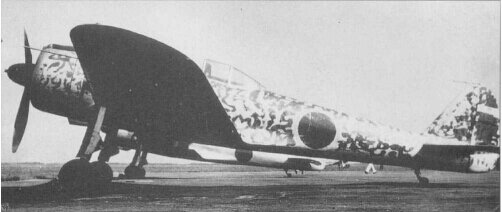 An MC-21 freight transport modified from a Ki-21-I and used by Greater Japan Airlines to fly cargo between Manchuria, China, and Japan. In the early war years, the Ki-21 was one of the best-known Japanese warplanes to the Allies, and it had the honor of receiving one of the first code names: Jane, after General MacArthur’s wife. Unfortunately, her name was actually “Jean”, and the good general made it known that he did not appreciate having a Japanese plane named after her, so Sally was quickly substituted. (Oddly, the Navy’s obsolete B4Y biplane torpedo-bomber was dubbed the Jean, but no one complained then!) Later, Allied Intelligence mis-identified the Ki-21-IIb as an entirely new aircraft, due to the greenhouse being replaced by the turret, so this version was named the Gwen at first. Ultimately, the mistake was rectified, and the former Gwen was renamed the Sally 3, the older Ki-21-Is and -IIs being referred to as Sally 1s and Sally 2s, respectively. Whether known as the Gwen or the Sally 3, the Ki-21-IIb was encountered from China to New Guinea; one of the best combat photos from the Pacific air war shows a “para-frag” bomb about to strike and destroy a grounded Sally 3 in New Guinea, which has been camouflaged with palm fronds. By 1943, Ki-21-equipped sentais outnumbered two-to-one those groups equipped with the later Nakajima Ki-49 Donryu (which see), the Sally’splanned successor. The Ki-21-IIa and -IIb were heavily involved in the Japanese offensive against India in early 1944, attacking Calcutta in addition to supporting the troops on the ground. Other sentais fought determinedly to slow the Allied advance from New Guinea to the Philippines, but their fighter escorts were badly outnumbered and the Sallys themselves were often destroyed on the ground by fighter sweeps. Losses were high, but the new Ki-67 Hiryu (which see) was becoming available, so the Ki-21 ceased production in September of 1944 and it was phased out of front-line units as quickly as possible. By the end of the war, only the 58th Sentai still operated the Sally as a bomber, most other survivors being used as communication or hack aircraft or for special missions. For example, the Japanese mounted an airborne commando attack on Okinawa’s Yontan airfield in May 1945; only one Ki-21-IIb, of the nine sent, survived the gauntlet of night-fighters and anti-aircraft, but it crash-landed on the field and the commandos did considerable damage to US planes and supply dumps before being killed. 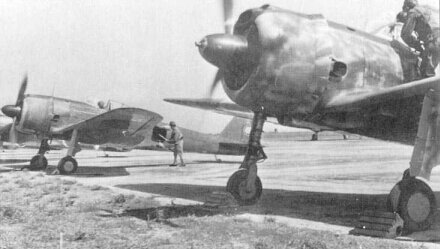 A Ki-21-IIb of the 14th Sentai over New Guinea, about to be attacked and shot down. In summation, the Mitsubishi Ki-21 contributed more than any other aircraft to bringing the Japanese Army Air Force to parity with foreign air arms from an equipment point of view. However, an adequate successor for the Sally was not ready in time, and this forced the use of the Ki-21 well past its planned operational career. Still, despite its obsolescence after 1942, the Ki-21 was well liked by its flight and ground crews for its pleasant handling characteristics and its ease of maintenance. Most of them preferred the Sally to its planned immediate successor, the Nakajima Ki-49. |